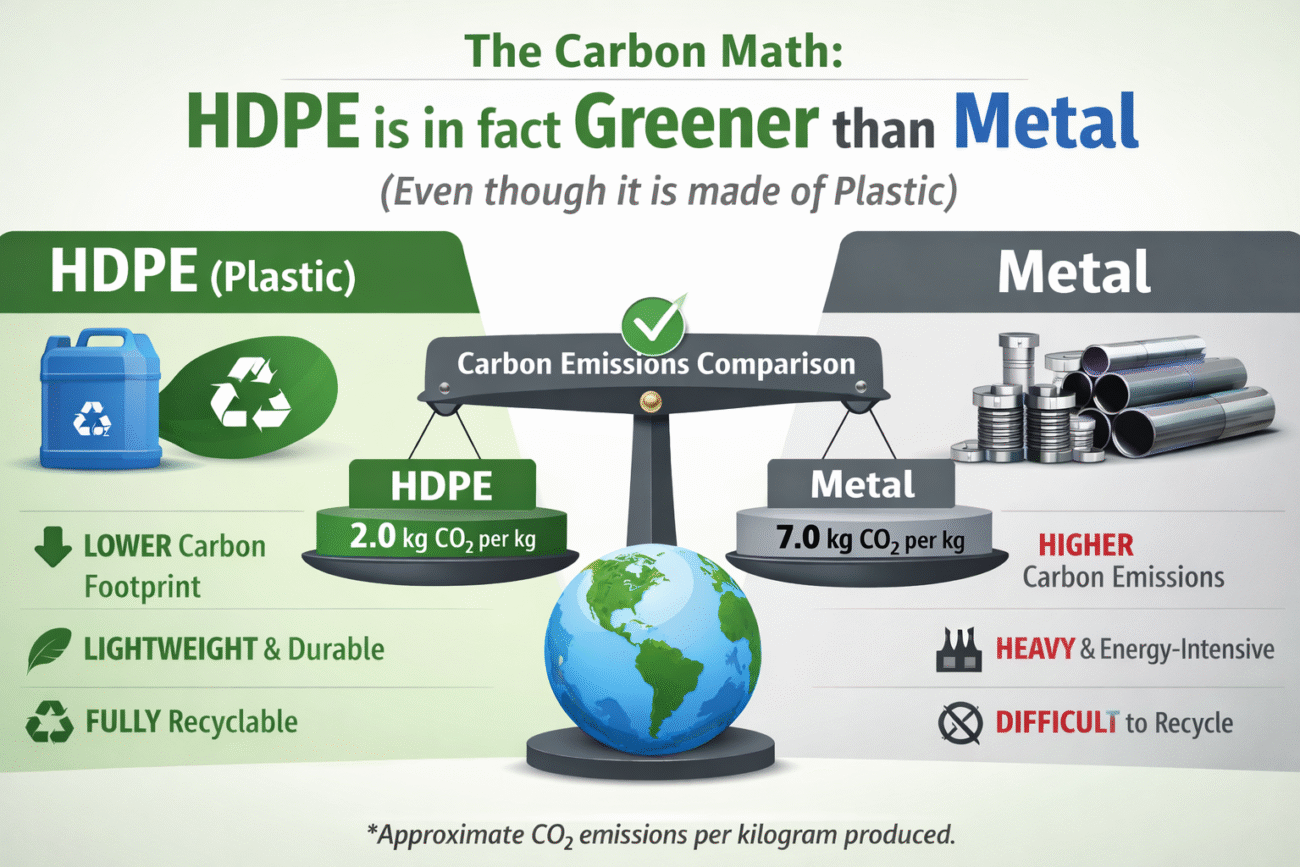
The term plastic has a lot of environmental stigma attached to it in the present-day construction and manufacturing industry. But as we look at the complete life cycle of industrial materials, the statistics give us an eye-opener. However, although metals such as steel and aluminium are also praised due to their ability to be recycled, often HDPE (High-Density Polyethylene) turns out to be the better option to consider when it comes to carbon-conscious projects.
The Lifecycle Logic of HDPE
The analysis of the environmental impact of a material should not only focus on the raw materials. The computation of carbon includes mining, production, distribution, and durability.
Reduced the intensity of Energy consumption in production.
The energy required to smelt
It consumes a lot of energy to smelt iron ore or refine bauxite into aluminium. On the contrary, HDPE polymerisation takes place at much lower temperatures. When one kilogram of high-density polyethylene is produced, the production usually yields fewer greenhouse gases than the production of the same weight of structural metals.
The Transport Advantage
In a large continent, the carbon cost of haulage is a significant element in the footprint of the project. The weight of HDPE is very lightweight relative to conventional metal piping or sheeting. This enables moving more material per truckload at a reduced amount of fuel usage, which has a direct impact on lowering the “Scope 3” emissions of a project.
Durability and Infrastructure Sequestration
The lifespan of a material makes it as green as possible. There have been cases of corrosion of metal infrastructure, particularly in the harsh coastal conditions of Australia and hence high rates of replacements and chemical treatment.
Corrosion Resistance: This polymer is resistant to rusting or rotting when in contact with salt spray or acidic soils, as opposed to steel.
Leak-Free Integrity In piping, heat-fused joints form a monolithic system to avoid the loss of treated water that was typical of older metal grids.
HDPE effectively seals off carbon in the form of useful infrastructure for over a century or more, as it lasts longer than 100 years without consuming energy in repairs and replacement.
Summary
When selecting sustainable materials, one must consider the whole data and not the general perceptions. The case of HDPE is very persuasive in terms of a lower-carbon future for Australian industries. The fact that it is lightweight lowers the emissions of transport, production is low-energy, and its durability is simple, which means that the resources are not wasted on repairing it all the time. This high-performance plastic product usually outperforms the heavy metal options when the math is performed correctly.
